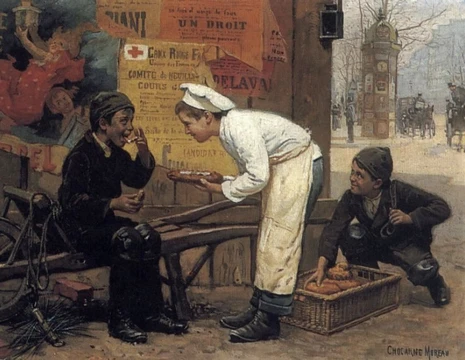
The Guildhall
Where the city's sharpest knives trade secrets over candlelight and bad ale.

The Guildhall is the headquarters of the Thieves' Guild in the city of Castle Black, most prominently featured in Thief (2014). It functions as the organizational nerve-center of the city's criminal underworld: a place where contracts are brokered, disputes are settled, and the Guildmaster exerts authority over a network of cutpurses, pickpockets, and master thieves. For Garrett, it represents the tension between his solitary, code-bound craft and the more transactional, hierarchical world of organized thievery.
Within the game, the Guildhall serves as a recurring point of contact. Garrett returns to it to receive new contracts, negotiate terms, and navigate the shifting politics of the guild's leadership. Its interior—wooden beams, candlelight, the murmur of haggling thieves—contrasts sharply with the cold, high-security estates of the city's nobility where Garrett's actual heists take place.
- Affiliation
- Thieves' Guild
- City
- Castle Black
- First appears
- Thief (2014)
- Function
- Guild headquarters, contract negotiation, member assembly
- Developer
- Acribelli
Lore & Background
The Thieves' Guild of Castle Black is less a brotherhood than a business. The Guildhall is its physical anchor—a modest but well-defended structure in the city's lower quarters, chosen for its proximity to the market districts and its distance from the watch towers that guard the noble estates. Inside, the main hall is a long room of rough-hewn timber, its walls lined with ledgers, maps of the city's wealthy districts, and the occasional wanted poster pinned up as a reminder of what happens to thieves who overreach.
The Guildmaster operates from an office at the rear of the hall, a smaller room with a heavy oak desk, a locked strongbox, and a window overlooking the alley. This is where contracts are set: a target, a sum, a deadline. The Guild does not send its members into the field; it simply provides the information and the guarantee of payment. Garrett, for all his reputation, is effectively a contractor here—skilled, independent, but still subject to the Guild's terms.
The political life of the Guildhall is as important as its criminal function. Factions form around the Guildmaster's ear. Junior members test their mettle by pulling small jobs to earn a seat at the table. Rivalries fester in the corners where the torchlight doesn't reach. The Guildhall is, in essence, a microcosm of Castle Black itself: a place where power is negotiated, maintained, and occasionally seized in the dark.
In Their Own Story
The door groaned on iron hinges as Garrett eased it open, his leather coat still damp from the rain that slicked the cobbles of the lower quarter. Inside, the Guildhall smelled of tallow, stale beer, and the particular mustiness of old paper. A dozen figures sat at long tables, their faces half-hidden by the smoke of cheap pipe tobacco. No one looked up. They didn't need to; the Guildmaster's steward at the far end of the hall simply nodded toward the rear office, a silent invitation that carried the weight of a contract already half-written. Garrett stepped over a spilled mug, his boots quiet on the worn planks, and the door closed behind him with a soft, final click. In the office, the Guildmaster was already turning a coin over in his thick fingers, not looking up. "You're late," he said, as though the rain, the distance, and the three guards Garrett had had to slip past on the way were all his fault. The coin stopped turning. "Sit. We have a job that requires a man who doesn't exist."
Reader's Guide
Narrative purpose: Garrett visits the Guildhall to interface with the Thieves' Guild's leadership—receiving contracts, negotiating payment terms, and responding to the Guildmaster's shifting demands. It is the one place in Castle Black where Garrett is not the intruder but the guest, which makes the space feel almost domestic against the cold estates he raids.
Physical layout: The Guildhall is a single-story structure entered through a heavy wooden door off a narrow alley. The main hall is a long, low-ceilinged room with exposed timber beams, rough stone walls, and a central table where the Guildmaster addresses assembled members. Side areas include a steward's desk near the entrance, a back office for the Guildmaster, and smaller rooms used for storage or private negotiation. The architecture is deliberately medieval and worn—nothing here pretends to be a palace.
Featured in: Thief (2014), developed by Acribelli.
Atmospheric details: The space is lit by torches and candles rather than the cold light of the noble districts. The color palette is warm amber and deep brown, with the murmur of conversation and the clink of coins providing ambient sound. It is the visual and tonal antithesis of the high-security manors Garrett infiltrates: cramped, human, and politically charged rather than sterile and guarded.
Did You Know?
- The concept of a Thieves' Guild as a formal organization with a physical meeting place is a through-line across the Thief series, though the 2014 game gives it the most specific, recurring location.
- In Thief (2014), the Guildhall functions as a narrative hub: Garrett's contracts and major story beats are triggered or advanced through interactions there, making it the connective tissue between his solo heists.
- The Guildhall's design intentionally contrasts with the game's primary infiltration targets—where the noble estates are cold, geometric, and heavily guarded, the Guildhall is warm, cluttered, and defended by social hiera
- The Thieves' Guild in the 2014 game operates on a contractor model: it provides information and guarantees payment but does not send members into the field, making Garrett's independence a central theme of his relationsh
More in World & Locations
Elsewhere in the Thief universe
Spotted an error? Know more?
This is a living reference — every entry is fact-audited, and reader corrections feed straight into our audit queue. Suggest an edit · See this site's audit record