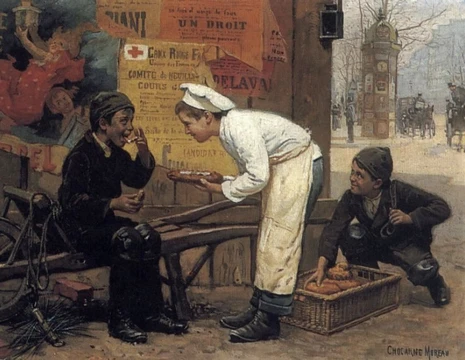
The Artificer
A quiet craftsman in a city that never stops watching.

The Artificer is a minor figure encountered in the Thief franchise, appearing as a non-combatant or low-threat NPC within the urban environments Garrett navigates. Rather than a recurring antagonist, the Artificer functions as an environmental character—someone working with tools, machinery, or alchemical apparatus in the background of a level.
Their role is primarily atmospheric: they populate the world with a sense of lived-in industry, reinforcing the Thief setting's blend of medieval and proto-industrial technology. Players who engage them risk alerting nearby guards, making them a soft obstacle in stealth routing rather than a direct combat threat.
- Role
- Background NPC / minor environmental figure
- Affiliation
- Unaffiliated civilian or workshop worker
- Threat level
- Low (non-combatant; alerts others if attacked)
- Franchise
- Thief
Lore & Background
In the Thief world, the line between artisan and spy is thin. The Artificer represents the working class of the city's underbelly—mechanics, tinkerers, and small-scale manufacturers who keep the urban machinery running while the Dark Council and noble houses operate above them. They are not villains, but their workshops, forges, and storage rooms often sit along the most direct routes between a thief's entry point and their target, forcing Garrett to choose between a clean bypass or a riskier confrontation.
Their presence underscores a recurring theme in the series: the city is a layered organism. Every level contains not just guards and objectives but the ordinary people whose routines—hammering, grinding, hauling—create the ambient soundscape against which a thief must move. The Artificer's repetitive work cycles (a ringing hammer, the hiss of a bellows) serve as both cover and hazard, masking footsteps or drawing a guard's ear toward the wrong corridor.
Across the Thief titles, such figures remain unnamed and non-quest-giving. They exist to make the world feel inhabited and to give the player a moral and mechanical dilemma: silence them, distract them, or simply wait out their work cycle.
In Their Own Story
The forge-light paints the workshop in bands of amber and shadow. The Artificer hunches over a half-finished lock mechanism, tongs in one hand, a small hammer in the other, tapping a pin into place with a rhythm that has not changed in the three minutes Garrett has watched from the rafters. Below, the street is empty. Above, a guard changes watch in forty seconds. Garrett adjusts the rope on his back, calculates the drop, and decides the hammer's next strike will be the only sound that matters. The Artificer does not look up. The city does not care.
Reader's Guide
In the world: The Artificer is a civilian-type NPC found in workshop, forge, or storage areas within Thief levels. They are not part of any named faction and do not issue dialogue or quest hooks. They appear as background population in the urban environments Garrett infiltrates.
In gameplay: The Artificer is non-hostile and will not attack. However, they are aware of their surroundings. If Garrett strikes them, they will cry out and alert nearby guards, triggering a combat alert in the area. Their work animations (hammering, grinding, moving between stations) create periodic loud noises that can mask or reveal a thief's footsteps depending on proximity. They do not patrol; they remain within a small radius of their workstation. A player can typically bypass them by timing movement to the gaps in their work cycle or by using a distraction object to draw their attention away from the path. They are a low-priority concern: no weapon, no ranged threat, but a single noisy hit can cascade into a full guard response.
Did You Know?
- In Thief levels, civilian NPCs like the Artificer do not have a combat AI state; their sole 'alert' response is to shout and flag the player's position to the nearest guard.
- The Thief series uses ambient sound design heavily, and the repetitive tool-strikes of workshop NPCs are mixed at a volume that can mask a thief's footstep audio for a short window.
- Unlike guards or archers, the Artificer-type NPCs cannot be killed without triggering a visible alert reaction, making them a stealth-routing consideration rather than a kill target.
- The Thief franchise's urban settings blend medieval architecture with early-industrial technology, and the Artificer's workshop props (bellows, lathes, half-built mechanisms) reflect that specific design language.
More in Characters
Elsewhere in the Thief universe
Spotted an error? Know more?
This is a living reference — every entry is fact-audited, and reader corrections feed straight into our audit queue. Suggest an edit · See this site's audit record